6 Client Retention Strategies for Your Digital Agency

Share the article
ShareFile for Your Firm
Secure document workflows your team and clients will actually use
Get StartedKey Takeaways
If you want to convince more clients to sign up for ongoing services, you need to demonstrate your professionalism and value from the very get-go. These six strategies can help build client trust.
When building digital products and experiences, the goal shouldn’t just be to attract one-time leads or prospects, convert them and then move onto the next. It’s far more expensive and time-consuming to constantly chase new business than it is to work on retaining customers.
The value of retained clients is immense. This is why you help your own clients build brands and digital products that inspire trust and loyalty.
But what about for your own business? Are you putting client retention practices to use?
In this post, we’ll discuss six strategies you can use to improve client retention and improve your agency’s long-term viability and profitability in the process.
How Much Does Client Acquisition Cost You?
There’s nothing wrong with working with clients who only want a website, app, portal or other digital product built. Or who need a one-time audit or optimization performed. However, if you’re looking to widen your profit margins and create some revenue stability for your agency, the ideal approach is to have more clients on retainer.
If you haven’t run the numbers before, take a moment to do so.
How much extra time do you and your team spend on new clients? Enter the number of hours you spend on each task (on average) per prospect/client:
- Look for available jobs or clients online
- Contact former or current clients and ask for referrals
- Manage lead form submissions and outreach
- Do an intro/prospecting call
- Put together a custom pitch or proposal
- Draw up a contract and scope-of-work document
- Follow up with the prospect to get everything signed
- Host a kickoff meeting (with client)
- Host a kickoff meeting (with team)
- Set up a new project
- Complete the client onboarding process
- Issue and follow up on milestone payments
You could also factor in time spent on offboarding one-time clients. This process might entail a wrap-up meeting, handoff of deliverables, training and other activities you wouldn’t do for retained clients.
With the hours now totaled, multiply it by your average hourly rate. This is how much more you have to spend to acquire clients.
If you could take all that time and money and use it elsewhere, what would you do with it?
6 Strategies to Retain More Clients
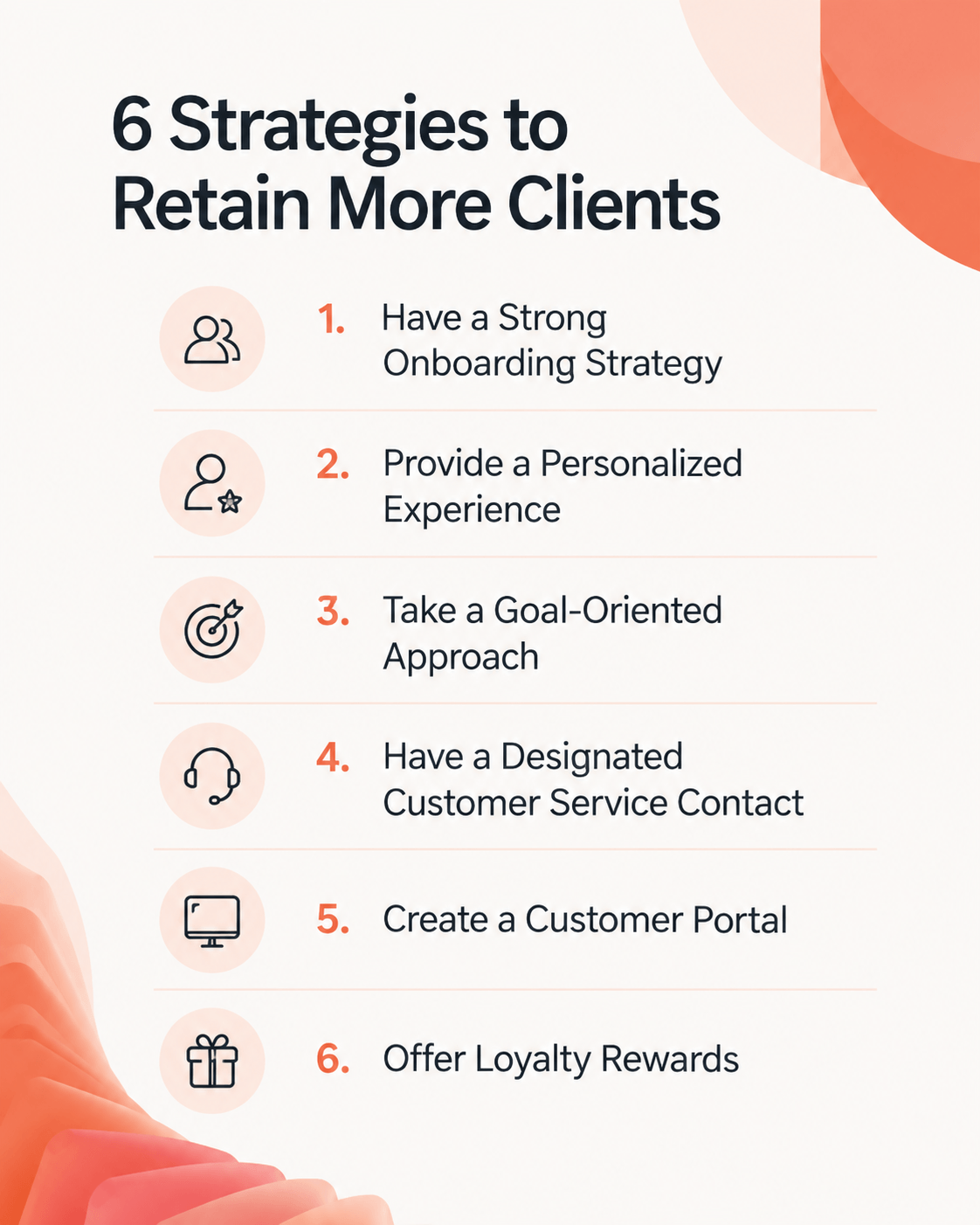
If you want to spend less time and money on client acquisition, here are some strategies that will help reduce client churn and improve retention:
1. Have a Strong Onboarding Strategy
Once you have a signed contract, it’s time to onboard the new client and to get things rolling on the project. While you may have interacted with them during the sales process, this is their real first impression of your agency and gives them a sense of what it’s like to work (and partner) with you.
What would you like them to take away from this first impression?
To build a strong onboarding experience, you might:
- Host a kickoff call to explain the process and establish the timeline
- Provide a summary of the project deliverables and goals
- Set expectations so they know what to expect from you and when
- Discussion about what you need from the client and why
- Establish systems (like tools you’ll use to coordinate and collaborate)
When you set a good first impression during onboarding, your clients will feel fully supported and guided by you. This gives them peace of mind and encourages them to let go and trust that you’ll take care of what they’ve hired you to do.
If you can consistently deliver on this promise throughout the rest of the project, they won’t just see your agency as a one-time hire. They’ll view you and your team as a trustworthy partner.
2. Provide a Personalized Experience
There’s a direct correlation between personalization and customer satisfaction and retention. For instance, a 2018 Google survey found that almost two-thirds of consumers expect that their interactions with brands will be informed by their personal preferences.
Now, a lot of this research related to personalization has to do with marketing. But that doesn’t make it any less relevant to direct interactions that consumers have with brands or companies they’ve hired.
So, how do you make this work in a digital agency? Here are some examples:
- Provide personalized quotes instead of a prepackaged offer
- Ask questions about their business (e.g., what they do, why they do it, what their internal goals are)
- Keep a record of the details they share with you in a centralized project management system
- Meet with them face-to-face and schedule occasional check-ins
- Tailor your process to their specific needs and goals
- Suggest upsells and cross-sells that actually make sense for them and bring real value to their business
- Send thank-you notes after the project wraps and follow-up to see if they need anything else
- Provide monthly reports so they have proof of value
According to a Deloitte report on personalization, 40% of consumers have bought more from a company because they offered a personalized experience. This can lead to big wins for agencies as 69% see higher customer lifetime values as a result.
3. Take a Goal-Oriented Approach
Although clients come to you to build a digital product or experience on their behalf, that’s not really what they’re asking for. What they want is help to achieve a certain goal.
For example, I recently had a client ask me to build a landing page. But I wasn’t just adding a new page to the site. What he needed was an asset that would upsell readers of his book. What’s more, he needed an automated pathway that would turn readers into coaching clients.
So, I designed the promotional page. I also did the following:
- Added a form to filter out ineligible leads
- Set up a custom scheduler to automate the coaching session sign-ups
- Created a Google Analytics account so we could learn more about who visited the page, the sources they came from and what they did next on the site
Ultimately, it’s your job to figure out your client’s why. The what is easy to figure out. They want a website, an app, a lead magnet, whatever. But when you figure out what this product will do for them, it allows you to be proactive and lay the right groundwork ahead of time instead of afterward. In the end, you can deliver better outcomes for them, too.
4. Have a Designated Customer Service Contact
If you’ve ever hired an agency before, you know how frustrating it can be when you end up speaking with a different person each time. Even if they all work from the same playbook, there may be inconsistency in their messaging as well as gaps in what some people know and others don’t.
Having a centralized source of truth (like a project management system) will help with this. But it still doesn’t help with how impersonal interactions may feel when clients always speak to someone new.
This is why it’s so valuable for digital agencies to have account managers. An account manager becomes the main point of contact for the client and the liaison between them and your team.
Everyone benefits.
Your team is free to focus on doing the job at hand without having to manage communication from the client. And the client has someone devoted to maintaining good communication and providing timely support and answers. It definitely creates an elevated experience for clients when they have a dedicated point of contact.
5. Create a Customer Portal
If you’re working with a high volume of clients, a customer portal could be really beneficial. Here are some of the capabilities you may want it to have:
- Share documents like contracts and change orders
- Provide a centralized system for communication
- Securely send files and request or submit feedback
- Give clients visibility into the status of their projects
- Send and follow-up on invoices
- Promote add-on services
- Allow clients to open tickets and request technical support
- Empower clients to manage (cancel, upgrade or modify) retainer services they’ve signed up for
- Request reviews/testimonials from clients
Whether they’re one-off or recurring clients, a portal gives them a reliable platform to manage their relationship with you. This is something they will remember if they ever try to work with another agency that doesn’t have a streamlined and well-supported management system.
It also enables you to automate some of the more tedious aspects of client management, like following up on late invoices and requesting reviews.
6. Offer Loyalty Rewards
The strategies above are more indirect ways to gain the respect and loyalty of your clients. But if you want to be more obvious about it, consider creating a loyalty program for your agency.
It doesn’t need to be super robust in order for it to be attractive enough for clients to opt-in either.
For example, you could keep it simple and offer a discounted rate for clients who sign long-term contracts. So, instead of paying $300 a month for website maintenance, you offer an annual plan for $3,000 (or, essentially, 2 months free).
If you want to set it up more like a traditional loyalty program, you could institute a points system. For example:
- 150 points for every 6 months of continued service
- 500 points for each successful referral
- 50 points for leaving a Google review
- 100 points for any service upgrade or add-on
- 500 points for their 5-year anniversary
For every activity they complete, they get a certain number of points which can be cashed out. They could put those points/cash towards their next bill, for instance. Or you might offer them gift cards (like 2,500 points for a $25 Target gift card).
Other ways to reward loyal, long-term clients is by offering them free extras that others don’t get access to, like monthly webinars, discounted services and networking opportunities with other clients of yours.
Wrapping Up
A strong client retention strategy does the following:
- Free your team to spend time on more valuable work
- Provide a consistent revenue stream
- Enable more optimized and streamlined workflows
- Improve business stability as well as employee confidence in the business
- Turn clients into brand advocates (and increase referrals in the process)
With more satisfied clientele, you’ll see your customer lifetime value grow.
Do you know what your customer lifetime value is? Or how it’s impacting your agency’s profitability? If not, use this link to run your own calculations and see how much more agile and scalable your agency could be if you increase your CLV this year. The numbers don’t lie.
Now that you have an idea of how much more client acquisition costs per lead and how much your CLV increases when you reduce user churn, which of the steps above are you going to take?
Topics
-
Client Engagement
-
VDR
-
File Management
-
File Sharing
-
Integrated E-signature
-
Apps and Integrations
-
Workflow Automation
-
Security and Compliance
Subscribe to ShareFeed Today
Stay ahead with the latest ShareFile releases, feature enhancements, and product updates delivered monthly straight to your inbox.

A former project manager and web design agency manager, Suzanne Scacca now writes about the changing landscape of design, development and software.