Balancing AI, Security and Trust in Modern Document Collaboration

Share the article
ShareFile for Your Firm
Secure document workflows your team and clients will actually use
Get StartedKey Takeaways
AI document tools should reinforce the core of what has always mattered in document collaboration: trust.
Trust has always been at the center of document collaboration.
When a business shares a contract, exchanges financial records or requests sensitive information from a client, it is asking both parties to rely on the systems and processes put in place to handle that information responsibly.
For most of business history, that trust was reinforced through a combination of professional norms, legal frameworks and the security infrastructure an organization had invested in.
Artificial intelligence has introduced a new variable into that equation. AI tools are now embedded in document workflows across industries extracting data, flagging anomalies, automating approvals and accelerating processes that once required significant human time. The efficiency gains are quite significant.
But AI also raises questions that some organizations fail to answer:
- Where does the data go?
- Who can see it?
- What happens when a model processes a document containing confidential client information?
- And how does this affect the trust that underpins the client relationship?
These are questions businesses adopting AI-assisted document tools should consider and address as part of a responsible AI governance strategy.
The Productivity Case for AI in Document Workflows
It’s easy to see why AI has found such rapid adoption in document-heavy environments.
Modern businesses process an enormous volume of information every day, from contracts and compliance submissions to financial statements, approval requests and internal reports. For many organizations, managing this volume manually is one of their largest operational bottlenecks.
AI helps reduce that burden in several ways:
- Intelligent document processing tools can extract structured information from unstructured files, such as pulling key dates from contracts, identifying missing fields in submissions or categorizing incoming documents automatically.
- Workflow automation can route documents to the right teams based on their content rather than relying on manual sorting and review.
- Natural language tools can summarize lengthy agreements in seconds, helping senior staff make decisions faster without reading every page in detail.
For growing businesses, these capabilities can influence whether a document process scales efficiently or requires organizations to continuously add headcount as workloads increase.
The productivity argument for AI in document collaboration is well-founded. The question is not whether to use it, but how to use it without creating risks that outweigh the benefits.
Why AI Raises New Security Concerns
The security risks associated with AI in document workflows are not primarily about the AI itself. They are about the data that AI processes and where that data goes in the process.
Most AI tools, whether integrated into a document platform or accessed as standalone applications, process data by sending it to an external model, often hosted by a third-party provider.
When that data includes confidential client information, financial records or personally identifiable information, the organization is extending its data footprint beyond its own infrastructure.
Depending on the terms of service of the AI provider, that data may be used to train future models, stored in jurisdictions subject to different legal frameworks or accessible to the provider’s staff under certain conditions.
At the same time, many organizations have adopted AI tools at the team or department level without a clear policy on what data can and cannot be processed through them.
The result is sensitive documents being handled by systems whose data practices have not been properly evaluated, maybe not out of negligence but because the adoption happened faster than the governance.
This isn’t a call to do away with AI. Rather, it does reinforce the need to be deliberate about which AI tools are used, under what conditions and with what safeguards in place.
Trust as a Business Asset; Not Just a Value
In one widely reported 2023 incident, employees at a large technology company reportedly entered sensitive proprietary data (source code, internal meeting transcripts and hardware specifications) into ChatGPT to help with routine tasks.
Within less than 20 days of the company allowing access to the tool, three separate incidents had occurred. The data went to OpenAI’s servers with no contracts in place, no data residency controls and no way to delete it. The company banned the tool shortly after.
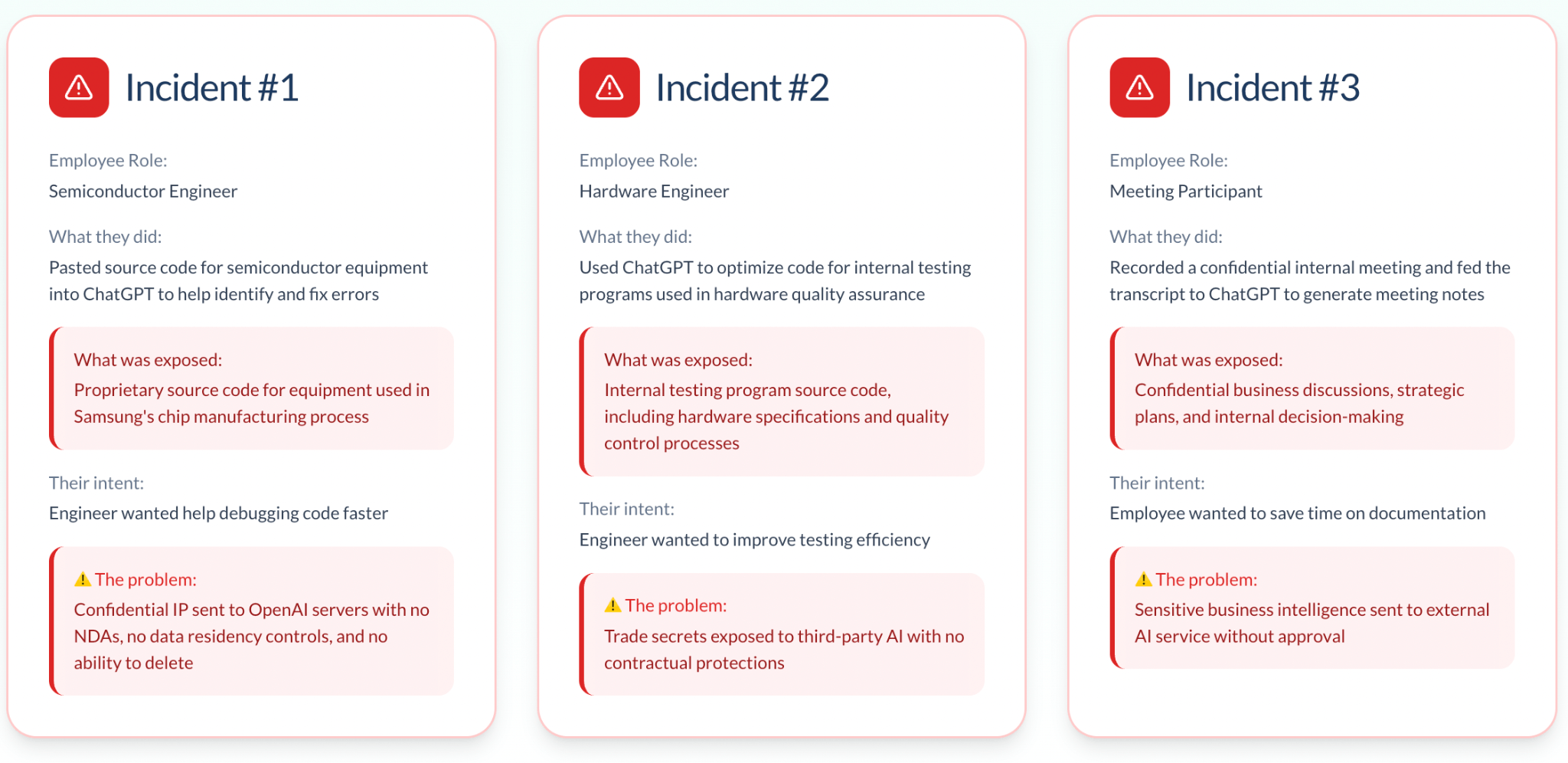
Source: AuthenTech AI
Employees may use AI with good intentions, but confidential information can move outside approved channels when governance is not clearly defined.
This is the trust problem with AI in document workflows, and it applies directly to client-facing businesses.
According to IBM, data mishandling incidents costs companies an average of $4.4 million in 2025, but the harder cost to quantify is what happens to the client relationship.
Transparency about how client data is handled (including whether AI touches it) is fast becoming a factor in how businesses are evaluated and selected.
This is especially true in professional services, legal, financial advice and healthcare-adjacent work, where data sensitivity is high and professional obligations around confidentiality are clearly defined.
What a Balanced Approach Actually Looks Like
Balancing AI capability with security is an ongoing discipline and the organizations that get it right tend to approach it at three levels:
Platform Level
At the platform level, the question is whether the AI tools in use operate within a defined security boundary. When a document is processed by AI, does that data stay inside the organization’s controlled environment, or does it travel to a third-party server?
According to Verizon, more than two-thirds (68%) of breaches involve a non-malicious human element. In an AI context, those errors can happen when people use tools without understanding where the data goes.
Policy Level
At the policy level, it means having clear internal rules about what categories of documents can be processed through AI tools and which cannot. Not every document carries the same sensitivity.
A blanket ban on AI can slow the business down unnecessarily, while unrestricted access can create avoidable exposure. The answer is a policy that matches AI use to risk level and communicates that policy to staff before an incident forces the conversation.
Client-Facing Level
At the client-facing level, it means being upfront. If AI tools process documents that clients submit, clients have a reasonable expectation to know that. Organizations that communicate their data practices clearly are better positioned than those that stay silent and hope no one asks.
The Organizations That Get This Right Will Define the Standard
AI in document workflows is not going away. The efficiency gains are real, and the competitive pressure to adopt is strong. The question that will separate businesses over the next few years is not whether they use AI but whether they use it in a way that clients can trust and regulators can scrutinize.
The standard is still being set, which means the choices made now carry more weight than they will once the market consolidates around a norm.
Progress ShareFile software is built on the principle that security and collaboration should not be in tension. Its AI-powered workflow automation is designed to operate within a defined security boundary, with security features such as encryption, access controls and audit trails built into the platform. For businesses that need to move quickly without expanding their exposure, that architecture matters.
Pair that with clear internal policies on what documents AI can and cannot touch, and honest communication with clients about how their data is handled, and the result is something that goes beyond operational efficiency.
It’s a demonstrable commitment to handling information responsibly, at a moment when that commitment is increasingly rare and increasingly visible. Trust, once earned at this level, does not transfer easily to a competitor.
Learn more about ShareFile workflow automation.
Topics
-
Client Engagement
-
VDR
-
File Management
-
File Sharing
-
Integrated E-signature
-
Apps and Integrations
-
Workflow Automation
-
Security and Compliance
Subscribe to ShareFeed Today
Stay ahead with the latest ShareFile releases, feature enhancements, and product updates delivered monthly straight to your inbox.

John Iwuozor is a freelance writer for cybersecurity and B2B SaaS brands. He has written for a host of top brands, the likes of ForbesAdvisor, Technologyadvice and Tripwire, among others. He’s an avid chess player and loves exploring new domains.
Related Posts