What’s Wrong With the Way Client Work Happens Today?

Share the article
ShareFile for Your Firm
Secure document workflows your team and clients will actually use
Get StartedKey Takeaways
- Client coordination is a hidden layer of work that includes chasing documents, clarifying requests, tracking status, and managing approvals.
- This non-billable work reduces capacity, interrupts higher-value work, and creates significant client coordination costs.
- As professional services firms grow, fragmented tools and informal processes become harder to manage and more prone to delays.
- Client workflows directly affect client experience, shaping whether an engagement feels clear, organized, and easy to navigate.
- Better client work management can reduce manual effort by centralizing requests, files, tasks, approvals, and communication.
- Firms should measure coordination costs and design structured workflows that protect both profitability and client relationships.
There is a kind of work inside professional services firms that rarely appears on a statement of work. A kind of work that sits inside client engagements like a second, hidden job.
It’s not the legal opinion, the audit findings, the advisory memo, the implementation plan, the valuation, the tax strategy. It’s not the expertise the client sought out, or the reason the firm was chosen.
It is the work around the work.
The asking. The chasing. The clarifying. The re-sending. The checking whether the right file came through. The wondering whether “final” means final. The small daily archaeology of searching through inboxes, chat threads, spreadsheets, signature tools, shared drives, and half-remembered conversations to understand one apparently simple thing: where are we?
Most firms do not name this work. They absorb it.
Seen together, these moments reveal the hidden cost of client work: the time, attention, and judgment spent holding an engagement together before the actual expertise can move forward.
Call it coordination work.
Coordination work is the labor required to move a client engagement from intention to completion when the people, documents, approvals, deadlines, and decisions are scattered across systems and organizations. It is the connective tissue of delivery. It is also strangely invisible, because when it is done well, it disappears into the appearance of competence.
This is one of its more dangerous qualities.
A partner spends Tuesday morning resending a document request list that should have been completed last week. An associate cannot begin the next phase of an engagement because one client form is still incomplete. A managing director fields a client call not about the quality of the work, but about whether anyone received the documents sent on Friday.
Each moment is small enough to excuse. A busy client. A missed email. A deadline that needed one more nudge. None of it looks like a system breaking. It looks like the ordinary texture of client service.
This, right here, is how the coordination chasm opens: not all at once, but through this day-to-day way of things.
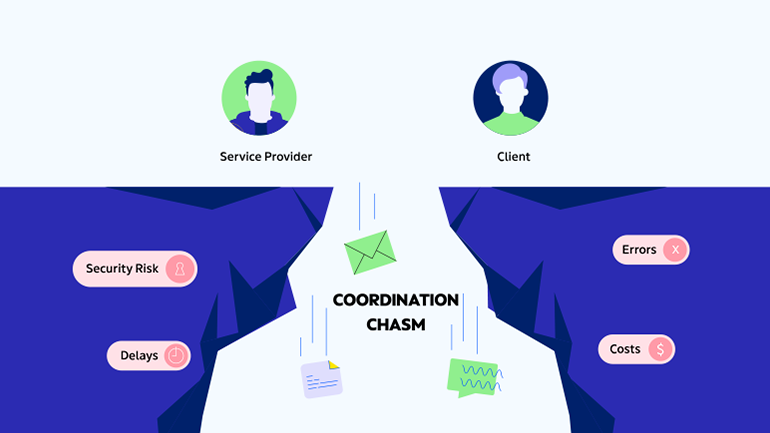
Professional services firms are unusually good at surviving bad process. They compensate with intelligence, stamina, and care. Good people remember what the bad system forgets. They smooth over gaps. They chase politely. They translate ambiguity. They hold the thread.
The work gets done. But getting it done can become its own form of waste.
The hidden tax
Professional services teams spend about 20.3 hours per week on non-billable client coordination activities: following up on documents, clarifying incomplete information, tracking status, and managing signatures. At the median billing rate, that adds up to $60,840 in annual client coordination costs.
What makes this cost difficult to confront is that it rarely arrives all at once. It accumulates in increments: a follow-up here, a clarification there, ten minutes spent locating a document, twenty spent confirming a status update. Individually, these moments seem too small to matter. Collectively, they become a tax on attention, margin, and judgment—the kind of cost that hides because no single line item is large enough to alarm anyone, while the total is large enough to change the shape of the work. This is the shape of non-billable work in professional services: necessary, fragmented, and difficult to see in aggregate unless a firm deliberately measures it.
For a long time, firms could treat this friction as tolerable. Clients hired expertise and accepted the surrounding friction as part of the relationship. A long email thread was normal. A spreadsheet tracking requests was normal. A project management tool built for internal teams was pressed into service for client-facing work and called “good enough.”
But this “normal” and “good enough” has a half-life. What starts as a manageable workaround hardens into infrastructure, until no one notices how much effort is being spent compensating for its limitations.
As firms grow, coordination stops being background noise and becomes weather. More clients equal more engagements in flight. That’s more approvals, more dependencies, more signatures, more late submissions, more exceptions, more places for context to fall out of the work.
The growth signal
83% of firms say growth has increased operational strain.
This is the cruel part: the coordination chasm widens at the moment a firm is succeeding.
Growth doesn’t only add volume. It tests architecture. The informal mechanisms that worked at one scale become fragile at the next. Coordination becomes a bottleneck. The spreadsheet becomes a bed of open-ended jobs. The inbox becomes a graveyard of decisions. The “quick catch-up” becomes a substitute for visibility.
At that point, client work management cannot continue to depend on individual memory, manual follow-up, or the ability of a few experienced people to hold the entire engagement in their heads.
The instinct is often to add more. More tools. More check-ins. More reminders. More people to hold the system together. But the issue is not always a shortage of effort. Often, it is the absence of a real system.
Email is expanded into a request handling space. Spreadsheets take on workflows. CRMs double up as visibility systems. Signature tools handle signatures, portals hold files, chat tools hold context, and someone is left to make the parts cohere. Each, by itself, may be useful. Together, they can become a set of fragments mistaken for a process. Hereon, every handoff creates another place where status can blur, context can vanish, and accountability can soften.
Clients may not see the backstage labor directly. They do not see the manually updated tracker, or the internal message asking whether the latest version is really the latest version. They do see the request that arrived in their inbox without context and clear instruction. The follow-up that came late. The folder link that did not feel secure enough.
They see what it feels like to work with your firm.
The client experience mandate
When asked what matters most in improving client engagements, 59.4% of professional services respondents selected better client experience—well ahead of faster service delivery and fewer errors or rework.
This matters because clients rarely separate the work from the experience of receiving it. The quality of the work matters enormously. But so does the atmosphere around it: whether the engagement feels clear or confusing, calm or effortful, intentional or improvised.
Indeed, client workflows affect client experience. A firm can deliver excellent work through a poor process. Many do. But it is a strange bargain. Expertise lands muddled when it arrives by friction. Trust is tested by ambiguity. The client relationship is forced to absorb what the system has failed to structure.
In firms built on judgment, nuance, and relationships, structured can feel like villains. But structure is not the enemy of expertise. It is what protects expertise from being eaten by its own logistics. It is a way of making expectations visible. It is a way of showing clients that their time, their submissions, and their engagement are being managed with care.
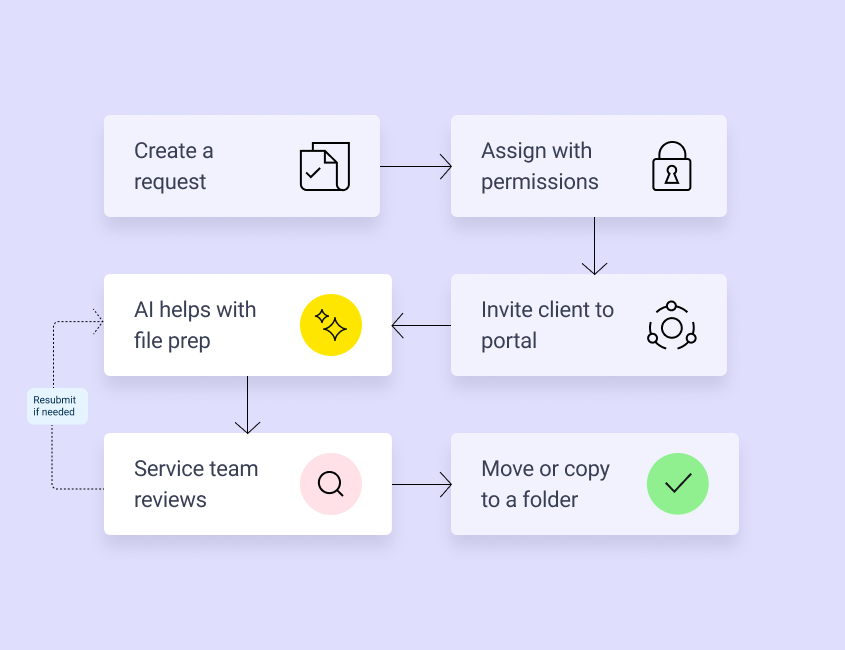
A clear request list with instructions, deadlines, and status is not administrative labor. It is a more respectful way to ask for what is needed. A single place for client submissions is not distance between firm and client. It is relief from scattered attachments and long email threads. A visible workflow is not micromanagement. It is how teams see issues before it becomes a missed deadline.
Structure, at its best, is a form of care.
The firms that understand this make delivery less wasteful and more delightful. They are asking a better question: not only “Did the work get done?” but “How much unnecessary effort did it take to get there?”
That question matters because client work should not feel hard by default. It should not require clients to search old emails to understand what is missing. It should not require teams to hold entire engagements together through memory and manual follow-up. It should not make coordination feel like the unavoidable cost of expertise.
Meaningful work needs clear systems and structures around it.
It is time to mind the [coordination] gap: to stop treating client coordination in professional services as invisible labor, and start treating it as a system worth designing.
The first step is to name the cost. The next is to measure it. A coordination cost calculator can help firms see how much time and money manual collection, clarification, and follow-up may be consuming—and what they could recover by bringing structure to the work around the work.
Progress® ShareFile® software helps firms bring that structure into client engagement through request lists, tasks, projects, e-signatures, files, and client portals designed to keep document-heavy work moving clearly from request to completion. By bringing these elements together, ShareFile supports more consistent client work management without asking teams or clients to stitch the process together themselves.
Calculate your hidden coordination costs with this cost-roi calculator
Learn more about how ShareFile enables better client engagements
Topics
-
Client Engagement
-
VDR
-
File Management
-
File Sharing
-
Integrated E-signature
-
Apps and Integrations
-
Workflow Automation
-
Security and Compliance
Subscribe to ShareFeed Today
Stay ahead with the latest ShareFile releases, feature enhancements, and product updates delivered monthly straight to your inbox.
.png?sfvrsn=db5ce71e_3 "Meeta Sharma, Product Marketing, ShareFile")
Meeta Sharma is a Product Marketing Manager at Progress ShareFile, focused on all things work management and how better workflows can improve productivity, client experience, and the way teams get work done.