Why Email Attachments Are Still a Risk for Businesses

Share the article
ShareFile for Your Firm
Secure document workflows your team and clients will actually use
Get StartedKey Takeaways
What issues can email attachments cause, and what’s a safer approach for sharing documents?Since the invention of email, it has basically been the default method for sharing business documents, thanks to its easy-to-navigate interface. For many teams, attaching a file to an email feels like the path of least resistance, and, ultimately, in low-stakes situations, it often is.
But the problem here is that most business documents are not low-stakes. Contracts, financial statements, identity records, compliance certificates, payroll data—these are files that can carry real consequences if they end up in the wrong hands. And email, by its simple design, was not built to protect them.
However, despite the growth of more secure alternatives, email attachments remain one of the most widely used methods for sharing sensitive documents in business.
This article breaks down the real issues behind email attachments, why they continue to create security and compliance problems for businesses, and what a safer approach to document sharing looks like.
Why Email Attachments Still Create Security Risks
These five reasons explain why email attachments remain a liability for businesses of any size:
1. Sending Files to the Wrong Person Is Easier Than It Sounds
Sending an email to the wrong receiver is one of the most common and often the most underestimated causes of data exposure in business.
If you try typing an email address and autocomplete suggests something close, just one tap of the enter key can result in a confidential document being sent to the wrong inbox.
According to the UK’s ICO, misdirected email is the single most reported GDPR-related cyber incident, ahead of hacking, ransomware and every other category.
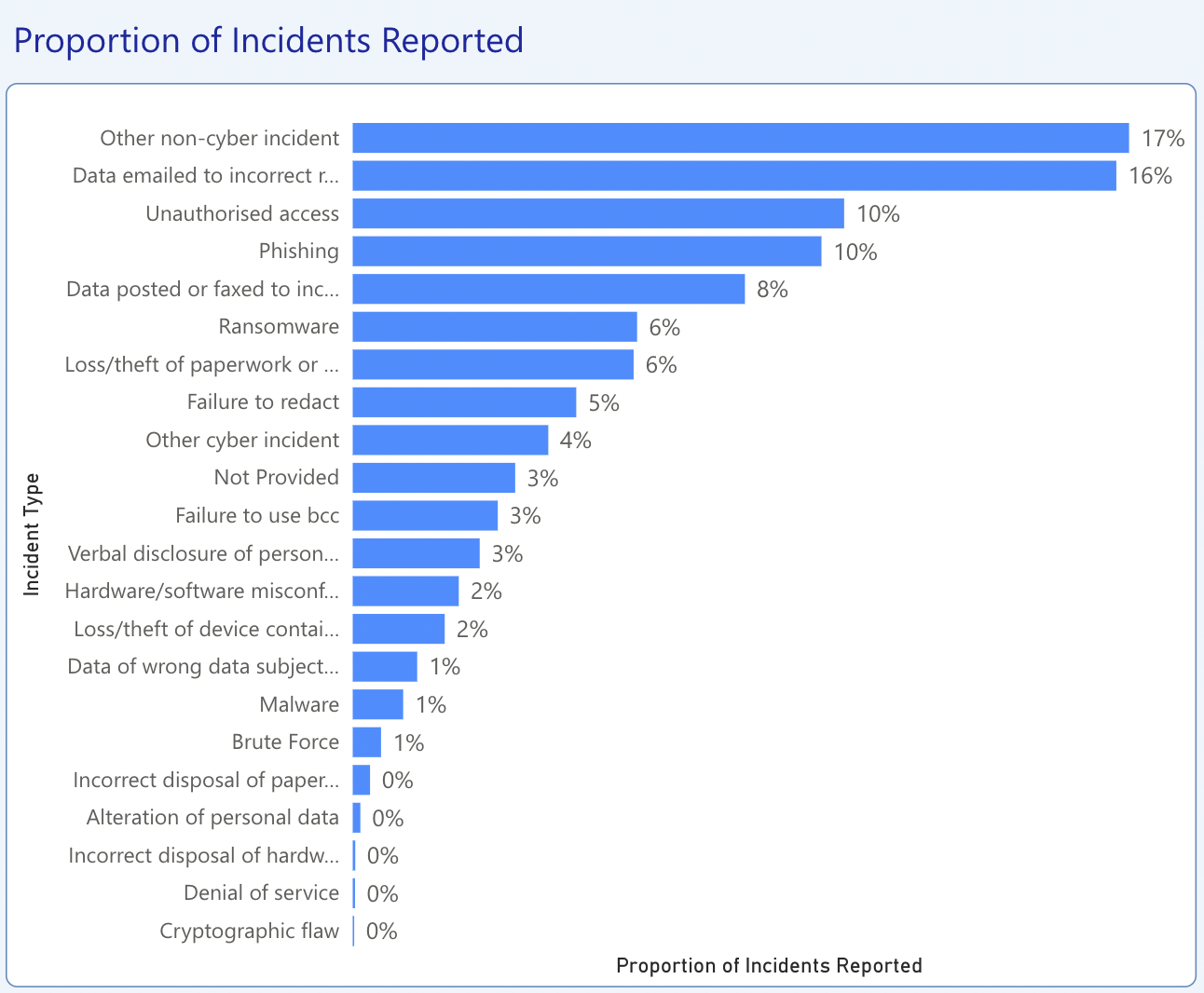
Source: ICO
And in many cases, the sender does not realize the error until the recipient replies or until they do not reply and something else goes wrong further down the line.
What makes this particularly difficult to manage is that there is no recall mechanism that reliably works once an email has been delivered.
Some email clients offer an undo option within a short window, but once the message reaches its destination, the sender has no control over what happens to that file. It can be forwarded, downloaded, printed or shared and the original sender will never know.
2. Email Attachments Travel Without Protection
When a file is attached to an email, it does not travel like a sealed package would. Depending on the email infrastructure in use (on both the sending and receiving side), a message may pass through multiple servers before it reaches its final destination.
At each point, [depending on the encryption configuration]encryption is not properly configured, the content of that email may be accessible to parties with server access. Most modern email providers use Transport Layer Security (TLS) to encrypt messages in transit, but this protection is only as strong as the weakest link in the chain.
If the recipient’s server does not support the same encryption standards, the connection can fall back to an unencrypted transfer. The sender typically does not have visibility into whether this has happened.
Beyond the transit, there is still the question of what happens to the file once it arrives. Email attachments are often stored without additional encryption controls in the recipient’s inbox, backed up as part of their mailbox and replicated across any devices where that email account is active.
A single attachment sent to one person can quietly exist in half a dozen locations that neither party planned for.
3. There Is No Access Control Once a File Leaves Your Inbox
One of the most significant limitations of sharing files by email is that the sender loses direct control the moment they hit the send button.
There is generally no way to set an expiry date on an attachment, restrict who can open it, prevent it from being forwarded to someone else or revoke access if circumstances change.
A contract shared during negotiations might still be sitting in a former employee’s personal inbox years later. A financial document sent to a client may have been forwarded to a third party without the sender’s knowledge. A proposal shared with one contact at a company may have been passed to a competitor.
For businesses operating in regulated industries or simply any businesses that handle sensitive client data, this lack of control can introduce operational challenges and potential compliance exposure.
Data protection regulations in many jurisdictions expect organizations to be able to demonstrate visibility into where sensitive data resides, who has access to it and how it is being used. Email attachments make that nearly impossible to prove.
4. Attachments Are a Common Vector for Malware and Phishing
The risk of email attachments is not only about what leaves your organization but more so about what comes in.
For example, email continues to be a widely used delivery mechanism for malware, ransomware and phishing attacks. Malicious attachments are designed to look legitimate: invoice PDFs, contract Word documents, spreadsheets from a known supplier.
Employees who routinely open email attachments as part of their workflow are operating in an environment where the line between a legitimate file and a malicious one is not always obvious.
Training helps, but it does not eliminate the risk. The more that email attachments are normalized as the standard way to share documents, the larger the attack surface becomes.
Reducing reliance on email attachments for document sharing can help both improve outbound security and reduce the volume of inbound attachments that employees need to evaluate, which may help lower the likelihood of a successful attack.
5. Version Control Breaks Down Quickly
Beyond the security risks, email attachments create a practical problem that affects operational accuracy: version sprawl.
When a document is sent as an attachment, edited by the recipient and returned, then edited again and resent, multiple versions of the same file begin to exist across multiple inboxes.
Without a single source of truth, it can become genuinely hard to know which version is current.
This is particularly damaging in processes where accuracy is non-negotiable, like compliance submissions, financial reporting or basically any workflow where a change made to the wrong version has downstream consequences.
The effort required to reconcile conflicting versions, confirm which one is authoritative, and correct any errors that resulted from the confusion adds up quickly.
A document management approach that keeps all versions in one controlled environment with a clear record of who changed what and when, helps address this problem. Sadly, email cannot do that, at least not yet.
What a Safer Approach Looks Like
Replacing email attachments with a more secure document sharing method may not require a significant change in how clients or colleagues interact with a business.
In most cases, it simply requires moving the exchange to a platform that is built for it.
A secure file-sharing platform like Progress ShareFile is designed to help organizations address key risks associated with email attachments:
- Files are encrypted in transit and at rest.
- Access is tied to authenticated users rather than open to anyone who receives a forwarded message.
- Shared links can be set to expire.
- Audit logs provide visibility into access activity.
And when circumstances change, access can be revoked or restricted without depending on the recipient to delete a file from their inbox.
This shift also has internal benefits: teams gain visibility into what has been shared, with whom and when. Documents live in one place rather than scattered across inboxes. And the compliance burden of demonstrating responsible data handling may become significantly easier to meet.
Learn more about the Progress ShareFile platform.
Topics
-
Client Engagement
-
VDR
-
File Management
-
File Sharing
-
Integrated E-signature
-
Apps and Integrations
-
Workflow Automation
-
Security and Compliance
Subscribe to ShareFeed Today
Stay ahead with the latest ShareFile releases, feature enhancements, and product updates delivered monthly straight to your inbox.

John Iwuozor is a freelance writer for cybersecurity and B2B SaaS brands. He has written for a host of top brands, the likes of ForbesAdvisor, Technologyadvice and Tripwire, among others. He’s an avid chess player and loves exploring new domains.