LBMC’s Jon Hilton and Charlie Apigian on Staying Human-centric While Embracing AI
Share the article
ShareFile for Your Firm
Secure document workflows your team and clients will actually use
Get StartedKey Takeaways
Two AI leaders in the finance space contemplate what it means to keep humans at the center of work.There is something innately, primally human about people having conversation face to face. And yes, I’m saying that video calls count as face to face. We live in the age of remote work, I take my wins where I can find them.
So I’d like to invite you to listen in on my conversation with two AI enthusiasts from LBMC, Jon Hilton, AI executive leader, and Charlie Apigian, AI practice leader, about keeping business human-centered even as businesses reach new growth potential with AI. And I’d like to start off with that most human of all experiences, a mistake:
Q: First things first. I would love to try to take a stab at pronouncing Charlie’s last name if I could.
Charlie: All right, go for it.
Q: I want two tries. OK, um, ah-PEE-zhian.
Charlie: OK.
Q: Hmm. Where else would we put that emphasis? APP-ah-ghean.
Charlie: Oh, that’s the one I hate. Anytime it starts with an Aaaa. You were close on the first one. Make it a hard G. So, ah-PEE-gyan.
Q: Oh, I’m so sorry. Oh no.
Charlie: So very close, and the first one I do not cringe at.
Q: Well, what a great way to start off the interview. Glad I made you cringe immediately out of the gate.
Charlie: Ha, that’s all right. No problem.
Mistakes are human. Which is why AI can be such a boon to companies looking to reduce human error and streamline systems and processes. But Jon and Charlie are both strong advocates of the idea that you can’t just shoehorn AI into a business without a plan, and with no thought for the humans that are already there.
As a professional services provider (finance, human resources, technology, information security, wealth advisory), LBMC is forward-looking around technology adoption, AI, automation and cybersecurity. But there’s also a huge emphasis on maintaining human-centered values, and that can seem like a real oxymoron. Even a contest of wills.
What does that even look like, to make sure that a large financial organization has human-centered values while still being forward-looking around AI adoption?
Charlie: Of course, we understand that AI is cutting hours in some areas, which allows us to do more of the thought leadership with our clients and the data strategy. And so before we even get into what we’ll build for you, we want to make sure it’s the right thing that we should build.
Jon: Let’s focus on AI handling the skills that can be automated and let’s let your employees and people that you’ve positioned in your company really work on the things that matter and have a lot of value.
So a small or medium-size business wants to continue to scale and grow without necessarily having to hire a ton of people. A good leader says I’ve got good people. I want to grow, but I want to do this in a way that I can grow with the people I have. That’s human-centered. It’s saying we have all kinds of potential, and I have a grand plan for the future, but I don’t want to do this by just adding people. Then you’re dealing with retention and attrition and the issues that come along with just keeping a really good team together.
Wouldn’t it be great if I could just keep and really focus on the team I have, continue to build great leaders doing the work they want to do, and not have to worry about adding more headcount just to keep up with the manual processes?
OK But What About Replacing Humans at Work?
Q: Mm. So it sounds like you are human-centered toward helping the founders of the medium-sized businesses grow, intelligently with minimal staff increases. Have you run across people who are like, I need to reduce my staff? I need to let people go. I want to run leaner, help me use AI to do that. Is that a conflict with being human-centered in your opinion?
Jon: If someone came to Charlie and me and was like, “I want to reduce my headcount,” I’d be like, “Hey, can we step back and look at what we’re trying to accomplish?” If someone did come to me with that and said, “Hey, look, this is really about me reducing headcount,” I’d say, “Why is that? What’s the problem we’re trying to solve? I’m not sure that’s the problem.”
To be fair, every organization may look at their headcount and go, for some reason, I’m not profitable. That’s the way I would approach it. Why is that? Let’s step back and ask what is the problem we’re trying to solve first.
Charlie: Yes, there are aspects of jobs that can be replaced, but you know, where people are seeing the gain is not in replacing an entire job with some completely automated thing. We just don’t have that now.
Listen, AI is going to take over tasks, and if done right, it enhances an organization. I’m not saying you still need 10 people to do certain things, but what John and I are noticing is the ability for AI to reduce the time to do something.
We’re seeing people do more, the stuff that they were hired to do. You know, it’s basically been the last hundred years that we’ve been forced into roles that are not human-centric at all.
Q: Oh? Can you expound on that?
Maybe Humans Were Never Meant to Work the Way We Have Been
Charlie: Yeah, I mean, if you think about it, it’s just as recent as the automotive boom that people started sitting on a production line and all they did was turn a screw all day. I don’t think humans were meant to be that. But at that time, we had no choice, right?
Then we got into computers, and the only way to add information into computers in the early days was manual entry. So now we have people doing stuff that was never what we are meant to do.
Get your employees back to talking to customers more, not doing the manual entry stuff. You’ve got to transform your organization and bring your employees along. And if you’re cutting people on day one, that’s not the culture you want to work in. We want to see people at the end-user or team level feel just as good about the use of AI as the senior leadership.
Jon: I think there’s this tendency to kind of stick to the construct that we know relative to work. And then we get really, really nervous about things that are going to change. With every industrial revolution, there usually is a flow of work that changes, right?
We’re not an agrarian society anymore. America pre-World War Two would freak out if you said, “Hey, by the way, we’re just going to be doing all this work inside this box called a computer. And there will be droves of people in offices.” They would say, “Oh, you’re changing everything.”
The first org chart that was ever created was associated with the industrial revolution for railroads. They had to be able to understand who was responsible for which track along a very long distance. And then I think IBM was the first one that did the hierarchical org chart. If you go look at that, it’s an interesting study.
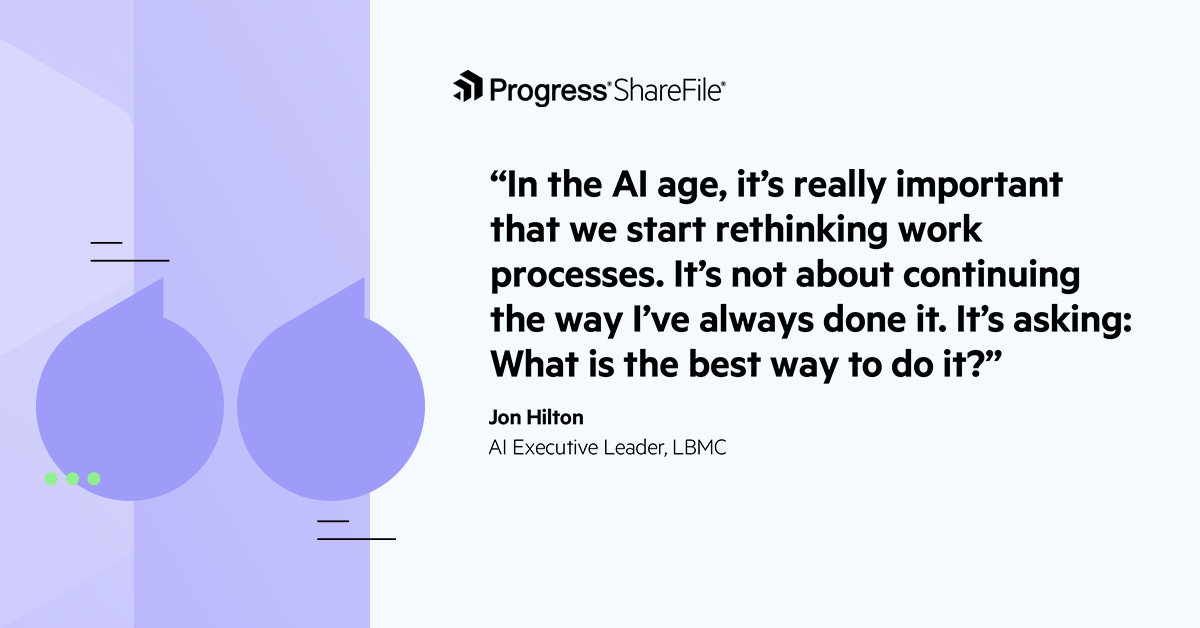
But this idea of the construct of work we have in the office today is something that hasn’t been here forever. In the AI age, it’s really important that we start rethinking work processes. It’s not about continuing the way I’ve always done it, it’s asking: what is the best way to do it? What was the original purpose of this work?
The purpose of the work that we can automate now was to help people fix some problem. It wasn’t that we wanted or needed to create all of this manual work around it, but that we had to.
But the real work still needs to happen, which is that we want to help people. People need things fixed. People need to get the services they need. We need to manufacture things. We need to be able to logistically move things around.
So there are a lot of things in the core part of work that are going to remain the same. It’s just maybe some of these contracts that we had to put in between to make it all happen might be shifting.
So How Can Leaders Respond to the Fear Around AI?
Q: I really like the throwback to other industrial revolutions. People’s jobs and roles in the professional world have definitely changed over the last hundred years. And on a big scale, progress is good. On a very human level, we have the people whose job might be the one that falls through the cracks. They’re the one doing the manual thing.
What would you say to a small- to medium-size business owner who says, “I want to do right by my people, but if I automate this job, I don’t need four people, I need one.”? How should they communicate that to these people? What do you say to a business owner who is sort of stuck with that human problem?
Charlie: We see the same things. People are confused, they’re overwhelmed by everything that’s out there. They don’t have the time nor the expertise to sit down and figure out what to do about AI. That produces more fear because they don’t know its possibilities. The fact is in small- to medium-sized businesses, you play softball with some of your people, you don’t want to get rid of them.
But at the same time, AI is not going away. So the answer is do it today. Start using it today. Have everybody in your organization be using it and empower them because wouldn’t it be great if everybody found value in what they’re doing?
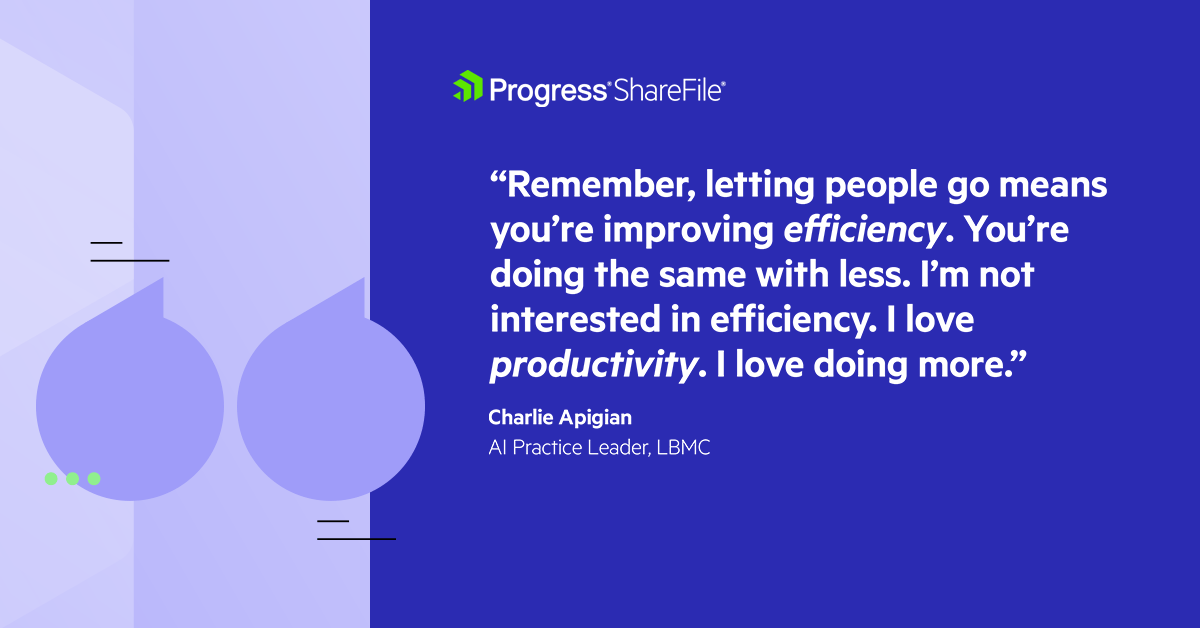
Remember, letting people go means you’re improving efficiency. You’re doing the same with less. I’m not interested in efficiency. I love productivity. I love doing more. If all we think about is replacement, then all we can do is reduce.
Q: I really like that juxtaposition, productivity versus efficiency. What I keep hearing from a lot of execs is efficiency, efficiency, efficiency, we want to be as lean as possible. I honestly have yet to hear: let’s take the man hours that we’ve been using and use them better. Not reduce the man hours, but use them in a more productive way or in a more creative way.
Charlie: That is a very narrow mindset of the possibilities of AI, if all they think about is replacing a human. The truth is, it’s just giving you a new capability. It’s accelerating knowledge. It’s giving you the ability to summarize. It’s doing things that enhance the human as opposed to replacing, if done right.
Jon: You do have to skill yourself in AI, though. And now’s the time to do it.
Charlie: Yeah.
Jon: Now this is partly a leadership problem. You can’t just go buy Enterprise ChatGPT, Enterprise Claude, Enterprise Gemini, then walk away as a leader going, “That’s my checkbox for the year.” All you did was say here’s a tool, drop it on your people’s desks, then walk away.
Tell me a single software or tool in your life where the implementers come in, they install it on everybody’s computer and walk away the next day and say good luck, run your entire financial and inventory systems off this, let us know how it goes.
The hours of change management and training that goes into implementation is unbelievable for every other software. But for some reason we just think because people may be using ChatGPT at home that I can just throw it in their work desktop and they’re just going to start moving with it.
Q: I mean, I feel like I’ve worked for companies like that.
Jon: So first and foremost, it’s about training. It’s not just on the individual, it’s on the organization to spend time, energy and effort on training. Ahem, Charlie does this, and we will do training for you.
Next, we get into the willingness of people, and there are people saying I’m not going to use AI, I don’t want to do this. You know, they have personal beliefs around AI, and to be fair, you can do that. But that’s kind of like going into your organization and saying, “Hey, I don’t align with your mission, your purpose or where you’re going.” So then, did you lose your job because of AI or because you just weren’t willing to really utilize this tool? And leaders are going to have to work through individuals that refuse to utilize AI.
We’re not seeing people say, “Use AI or get out.” It’s more like, “Use AI, and leaders are going to reward performers.” You will have employees that are going to be doing tons of work with AI, and those that are not are going to be. It’s going to be night and day clear who is and who’s not using AI. And so part of it is, if you just want to remain competitive in your own job, you better start using it.
Q: So as a partner, how do you come alongside these businesses and help them address the fear that is going to come up in their company? What do you say to the person who’s 50, and they’re looking at retirement, and they’re like, what am I going to do? How do you work with leaders to sort of calm that?
Charlie: Yeah, we didn’t see any good frameworks out there. So we built it ourselves. I’ll work with senior leadership and break it into three easy components. First and foremost, simplify the complex. It’s scary because you don’t understand it, and people fear what they don’t understand.
Then we take a step back and think of it strategically. What is it that the organization wants? Actually, literally create a vision statement and say here’s why we’re going to use AI. And then we break it into measurable objectives and AI use cases below that.
And the last thing is just to act. Just do it. Find a use case that’s low risk, high reward, something that people in your organization will think is a no-brainer, and there’s always one. There’s always a redundant task that nobody wants to do, or wouldn’t it be great if we could find a way to get this data to our fingertips. Those are easy use cases where everybody’s like, “Wow, that’s kind of nice.”
And we can show them so much more, but you’ve got to start. Simplify it, be strategic, then act.
And I even suggest that individuals create their own personal AI vision statement. Mine is pretty simple, and it’s my North Star. “I use AI to create richer experiences and deeper connections with people while staying genuine and authentic.” And that creates my barriers for when I will and will not use AI. Everything goes toward taking things off my plate so I can get back to doing what I love to do, which is talking and being around people.
My joke is always that I just want to spend time petting my dogs. If I’m in my office doing AI and it’s taking me away from that, then shame on me because I set up my strategic vision to be that.
When we do the same thing with companies, we find that the use cases are so much richer, so much more powerful than the replacement way of doing AI.
OK, Middle Market—What’s Your AI Plan for 2026?
Jon: For me, if I can summarize, I use AI to be a more effective leader and to focus my time on my people and our mission. I need to be all in on my people.
And to other leaders, especially middle market, I would say tell me what your budget is for AI this year. This is going to move fast and it’s going to have transformational impact. If you’re just delegating these decisions to your CIO and you’re pushing it deep into your IT organization, you’re not understanding how transformational AI can be to your business. Your involvement with your company’s AI needs to go beyond the vendor selection of your next AI tool. How are you going to change the organization?
For you to maintain competitiveness, you need to be acting now. If your answer is, “I bought ChatGPT and Copilot last year,” that’s table stakes. Everybody has that, my kids are using ChatGPT.
Middle market businesses need to figure out what their road map is. What are the two or three strategic AI use cases that Charlie was talking about that will really move them as an organization? Put budget around it, put people around it, find a partner if you don’t have people inside your organization to start doing this. Pilot some things and be OK with failing on some of them.
Charlie: Yeah. We’re still talking to people that are deciding whether they should do anything with AI or not, and we get that mostly in the small- to medium-size businesses.
And I want to emphasize what Jon said, don’t be afraid of failure. Tell me anything you’ve done in your life that’s brand-new where you succeeded on the first try. So the first use case is a test to see how people adapt. What do they do? Do they get excited? Do they get fearful?
Again, we’re looking for the small, quick win. We like doing the big ones, too, but that should not be your first one. It should be simple, even if it’s just a class on Copilot or ChatGPT. And if that’s the first thing you do, that’s still more than you did yesterday. I think that’s important. It’s OK if the reason you try something with AI is because you’ve got to practice.
Jon: Yep.
Charlie: That’s so that when you have no choice but to implement AI to make an idea successful, it shouldn’t be your first time using it in your organization.
Q: The idea of finding that low-risk, high-value use case feels very bite-size, very actionable. Do you have any tips for someone who maybe doesn’t even know how to find that use case? Should it just be obvious to a good leader, or is it something you have to sort of look for?
Charlie: I think it’s systematic, and once you go through a process, it makes complete sense. It’s a process question, not a technical question. Look at your process and ask: where do I have the ability to extract, summarize, guide, recommend, act? Look at the user journey that goes through that. Where are there processes that could be improved, and can AI be that improvement?
All of a sudden you’ll see the use cases. Anytime you bring it back to processes, you’ll figure out five more use cases pretty quickly.
Jon: And rather than looking across your entire company, pick one or two business domains and say, “This is where we want to start.” Eventually you’re going to pick one or two use cases that you feel have a lot of value. They’re lower complexity. Your people will be inspired by this. You could get a quick return on it.
Don’t let your new AI tool become the new mega monster behemoth platform that’s going to solve all the cures.
Q: All right, we have a little less than 10 minutes left, so I’m gonna let you guys add any final thoughts. Anything you’d like to expound on?
Jon: I hit on this earlier, but I am very concerned for those that are sitting and waiting. I really am. There is a fundamental shift happening, and I believe thoroughly that if you do not have an AI roadmap, if you are not putting budget toward this right now in this quarter, you face some real substantive risks heading into your future.
If you look around and you have no competitor, maybe you’re good to go. If you have a competitor, there’s no moat on this for you. Your ability to catch up is going to be difficult if you’re not starting it now. If you sit on your hands in ’26, you’re going to be desperately doing this later and probably in a manner that’s not deliberate.
Charlie: Well, there’s your urgency. My whole point behind writing AI Reimagined was to help people jumpstart their AI journey in a way that I hope is positive and grounding and using words that even my mom can understand. It had to be a relatable book and it goes through some of that urgency and walks leaders through a five-step process from vision to identification to strategic alignment. And then I purposely wrote it where you could finish it in a day. It’s a three- or four-hour read.
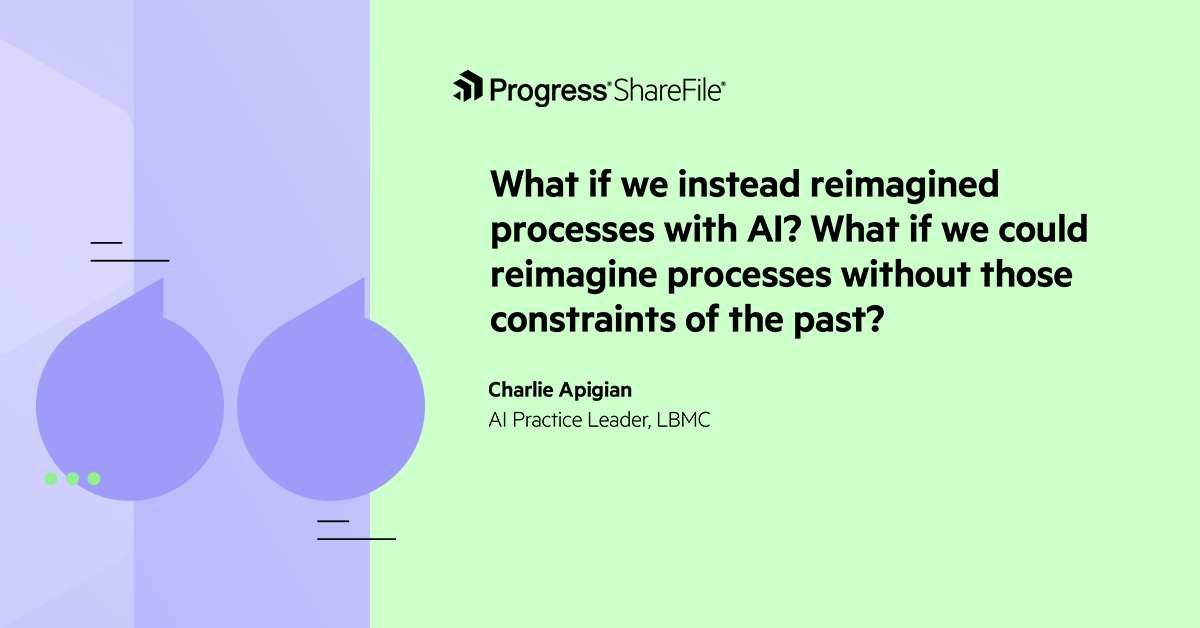
I got tired of people talking about replacement, and I was like, stop that. What if we instead reimagined processes with AI? What if we could reimagine processes without those constraints of the past?
Learn how LBMC modernizes accounting with ShareFile software and an AI-forward approach. Read the LBMC case study.
Topics
-
Client Engagement
-
VDR
-
File Management
-
File Sharing
-
Integrated E-signature
-
Apps and Integrations
-
Workflow Automation
-
Security and Compliance
Subscribe to ShareFeed Today
Stay ahead with the latest ShareFile releases, feature enhancements, and product updates delivered monthly straight to your inbox.