
BLOGS

Digital Signature vs Electronic Signature
Share the article
ShareFile for Your Firm
Secure document workflows your team and clients will actually use
Get StartedDigital signatures vs. electronic signatures: an introduction
Digital and electronic signatures are often confused as the same but are quite different. Each has its own distinct functionalities and legal implications. Advancements in encryption and digital security put digital document signing on the map in the late 1990s and early 2000s. By the mid-2000s it became more accepted as standard practice in business.
Globalization, remote work, and the increasing digitization of business processes grew both markets. Between 2024 and 2032 the digital signature market value is projected to go from $7.04 billion to $66.01 billion. The global electronic signature market value is expected to grow to $43.14 billion by 2030.
As use of these signature types continues to increase, it’s important to understand the nuances. From legal validity to identity authentication to document integrity and more, you must consider the needs and requirements of specific situations to choose a signature method that is right for your business.
In this article, we outline what these two signature types are and discuss the benefits and limitations of each. We also explore the difference between both digital signatures vs electronic signatures, provide examples, and outline how you can determine which is right for your business.
What is an electronic signature?
An electronic signature, also called e-signature, is any method or process that signals electronic acceptance, authorization, or approval of a document or transaction. Here are the five most common types:
- Scanned signature: Uses a digital image of a handwritten signature.
- Typed signature: Creates a signature by typing out the name or initials of the signer.
- Click-to-sign: A checkbox or button is clicked to indicate acceptance or agreement.
- Biometric signature: Uses biometric input like a fingerprint, eye scan, or signature pad.
- Digital signature: Applies cryptographic techniques to verify the authenticity and integrity of a document (more on this in a bit).
Benefits and limitations of electronic signatures
E-signatures offer convenience, efficiency, and flexibility when signing legal documents. It’s generally easier to implement and is used in everyday transactions like email communications and online contracts.
Here are seven key benefits over traditional paper-based signatures:
- Convenience: Allows documents to be signed anytime, anywhere, on any internet-connected device.
- Efficiency: Streamlines the signing process, cutting down delays and speeding up workflows.
- Cost savings: Eliminates expenses from printing, shipping, and storing paper documents.
- Security: Protects the integrity and confidentiality of signed documents with encryption, authentications, and audit trails.
- Compliance: Helps ensure compliance with legal and regulatory requirements for document signing.
- Environmental sustainability: Reduces paper use and the carbon footprint created when printing, shipping, and storing paper documents.
- Improved customer experience: Enhances satisfaction and loyalty with convenient and seamless document signing capabilities.
On the flip side, there are limitations to watch out for.
- Legal recognition: Requirements or restrictions regarding e-signatures means it may not be legally recognized across jurisdictions or for all types of transactions.
- Authentication: E-signatures can be susceptible to impersonation or fraud and don’t always give the same level of assurance of signer identity as handwritten signatures.
- Document integrity: Electronically signed documents may be vulnerable to unauthorized alteration, especially if stored or transmitted insecurely.
- Dependence on technology: Reliance on technology platforms and infrastructure are subject to technical failures, cyberattacks, or becoming outdated.
- User adoption: Concerns around security, privacy, or unfamiliarity with digital signing technology can cause hesitancy to adopt e-signatures.
- Complexity: Implementing e-signature solutions that are compliant with regulatory requirements can be complex and time consuming.
- Interoperability: Proprietary formats and protocols create challenges when exchanging signed documents between systems.
What is a digital signature?
A digital signature is a type of e-signature that gives a higher level of security and authenticity to help prevent fraud. Digital signatures are tied to the signer and document, proving to the receiver that the document has been signed by the correct person.
It is typical for digital signatures to be used for legally binding contracts, financial transactions, and government documents. Let’s outline five common ways to create a digital signature.
- Public key infrastructure (PKI): The signer uses a private key to encrypt a hash value of the document, resulting in a digital signature attached to the document. The recipient can verify the signature with the signer’s public key, confirming document authenticity and integrity.
- Digital signature algorithms: Cryptographic algorithms generate digital signatures based on the signer's private key and the document being signed. There are different types of cryptographic algorithms that can be used like RSA, DSA, and ECDSA.
- Hash functions: These are used when creating and verifying digital signatures. A hash value represents a unique fingerprint of the document and is encrypted using the signer's private key to create the digital signature.
- Digital signature certificates: Also known as digital certificates or public key certificates, digital signature certificates validate the signer’s identity. It has the signer’s public key and other identifying information and is commonly used in PKI-based digital signature systems.
- Biometric signatures: Biometric data like fingerprints or iris scans create unique digital signatures. These provide more security and authentication because of the use of physical characteristics that are unique to each individual.
Advanced electronic signatures (AES)
An AES is a special type of digital signature that meets the requirements in the eIDAS regulation. AES gives more authenticity, integrity, and legal validity for electronic signatures in the European Union.
To qualify as an AES, the signature must be:
- Uniquely linked to, and identify, the signer
- Based on a qualified electronic signature creation device, like a signature pad
- Under the control of the signer and not able to be duplicated by others
- Capable of detecting changes made to the signed document
Benefits and limitations of digital signatures
A secure, efficient, and legally recognized method for signing documents electronically, digital signatures provide a lot of benefits. Here are eight:
- Security: Uses cryptographic techniques to provide strong protection against tampering, forgery, and unauthorized changes.
- Authentication: Helps prevent impersonation and fraud by assuring the signer is who they say they are.
- Non-repudiation: Prevents risk of later disputes with concrete proof the signer agreed with the contents of the document at the time of signing.
- Efficiency: Saves time and resources by eliminating the need for printing, scanning, and physical delivery of documents.
- Cost-savings: Lowers the need for paper, ink, postage, and administrative overhead associated with paper-based signatures.
- Global accessibility: Allows documents to be signed and exchanged remotely, making collaboration and transactions more efficient.
- Compliance: Supports compliance with legal and regulatory requirements for document signing.
- Environmental sustainability: Reduces paper use and carbon footprint from printing, shipping, and storing paper documents.
Digital signatures have similar limitations to what we outlined above for e-signatures. Additionally, because of a more complex process and infrastructure, capturing digital signatures takes longer than e-signatures, making this approach less convenient.
Adding to the inconvenience factor, the use of private keys to verify the validity of digital signatures will need a key-management strategy. This is because if private keys are compromised in any way, the digital signature may not be legitimate, invalidating the signed document and undermining security.
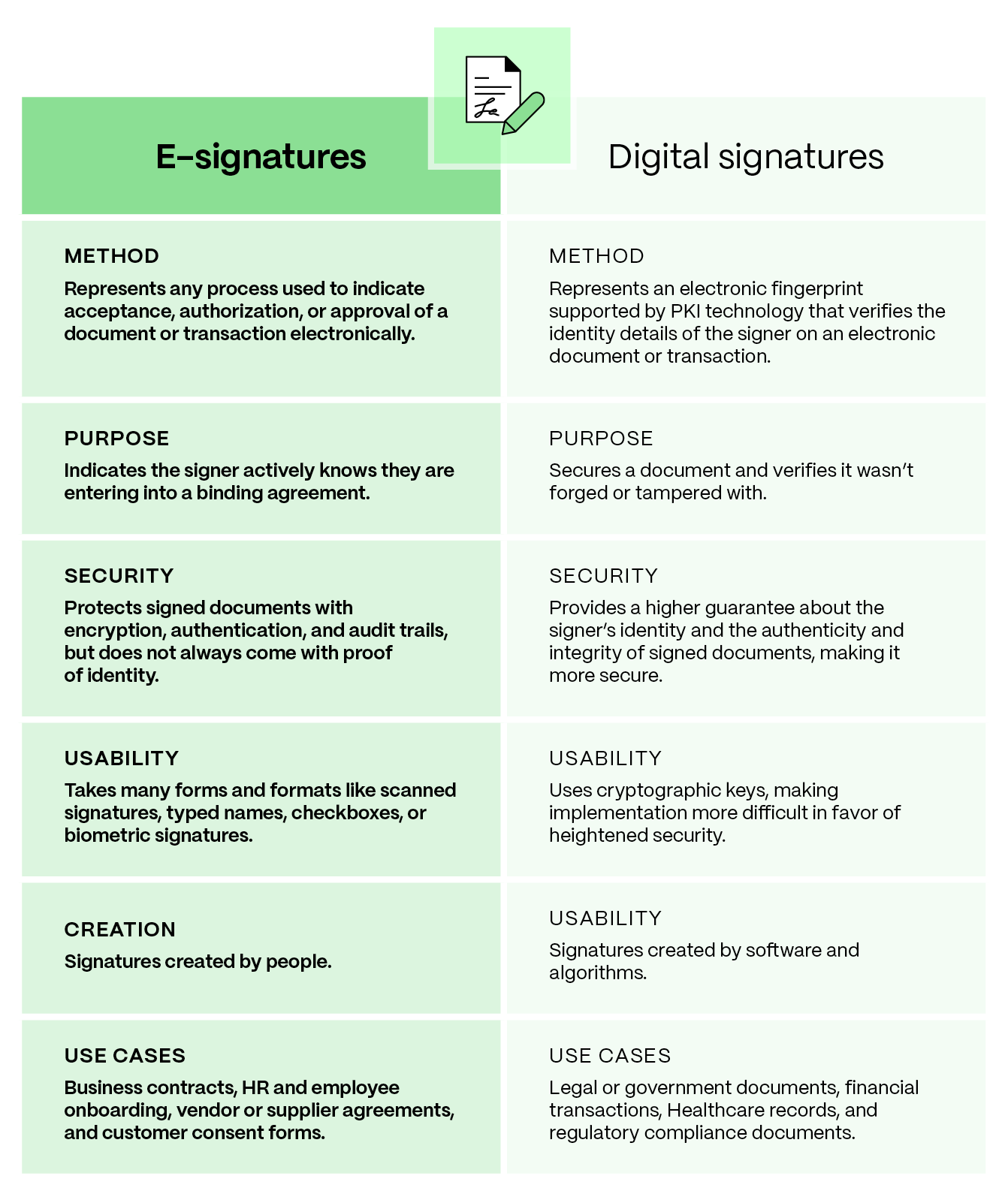
What is the difference between e-signature and digital signature?
Now that we’ve defined what each signature type is and outlined the potential limitations and benefits, let’s dig into how these differ. There are specific nuances that differentiate an e-signature and a digital signature.
What is a digital and electronic signature example?
The most common example of a digital signature is a digital document signature. These signatures can also be used for online authentication such as server-to-server or client-to-server, email encryption, and even software authentication.
Examples of e-signatures range from a typed name at the end of an email or document to using a stylus to draw a signature on a pad (think grocery or retail transactions). Wet — or handwritten — signatures are often uploaded as a digital image and added to documents as an electronic signature.
Electronic vs digital signatures: which one is right for your business?
Digital signatures and e-signatures perform different functions, so it’s not always a matter of picking one for your overall business. Rather than thinking of it as digital signature vs. e-signature, consider what you need for each document or transaction that requires a signature. In some cases, your business may need both.
Unsure of what you need? Don’t worry. The following four questions will help guide you to the right decision for your business.
- Do you need a simple way to add signatures to documents and agreements? If yes, e-signatures alone can provide what you need.
- What level of security and document integrity do you need? This will determine if an e-signature suffices or if a digital signature is needed for more security.
- Are you looking to enhance security and reduce the risk of tampering or forgery? If yes, consider using an e-signature and strengthening it with a digital signature functionality.
- Are there specific regulations or laws around signature types that are accepted in the country or region the signer is in? Some places do not view e-signatures as legally binding in any situation, so knowing this ahead of time will help you decide.
Move forward securely, with confidence
Whether you are handling highly sensitive information that requires layers of security or looking to digitize the process of signing documents, the information in this article can be a guide as you consider the signature type(s) you need. There is, in fact, a difference between e-signatures and digital signatures. Understanding that is crucial, especially when legal validity and security are significant concerns.
By reading this article you are already on your way to finding the best fit for your business. There are plenty of tools available to help your business securely and confidently capture signatures online. Watch the short, one-minute video below to see how ShareFile empowers users to get anything signed in seconds with e-signature technology.
Topics
-
Client Engagement
-
VDR
-
File Management
-
File Sharing
-
Integrated E-signature
-
Apps and Integrations
-
Workflow Automation
-
Security and Compliance
Subscribe to ShareFeed Today
Stay ahead with the latest ShareFile releases, feature enhancements, and product updates delivered monthly straight to your inbox.
Related Posts